Tuesday, December 11, 2012

1980 Comic Strips: A Summary

Source: Curtis, Dal. Rex Morgan, MD. 25 Aug - 31 Dec 1980, Field Newspaper Syndicate (Irvine, CA).

All comic strips are posted online by special permission of King Features Syndicate, Inc.
  • January 1 - August 24: MISSING
  • August 25 - xxx: Paul Brant, the near-deaf boxer, and Babs Van Kirk, MS
    • New signature on strips - "daSilva". Fernando da Silva had a short stint as artist between 1980 and 1983.
    • Babs Van Kirk is a young woman buying a contract to manage boxer Paul Brant, whom Rex is seeing for a physical exam - he has 50% hearing loss
    • Paul's trainer defends him, makes general statement about the hearing-impaired (10/17/1980) - incidentally, this might be the first black person drawn in the strip?
Rex Morgan, MD - October 17, 1980   © King Features Syndicate
    • All the comments about hearing impairment discrimination makes me think Dallis had some personal experience with this - it also reminds me of how Proactiv (acne face wash) is marketed by celebrities to make acne seem more socially acceptable
    • Teaching strip on how to seek medical attention about hearing loss (11/20/1980)
Rex Morgan, MD - November 20, 1980   © King Features Syndicate

    • When Babs suddenly loses vision in her left eye, Dr. Morgan admits her, with suspicion of optic neuritis and multiple sclerosis
    • Another special Christmas strip
Rex Morgan, MD - December 25, 1980   © King Features Syndicate

Sunday, October 21, 2012

1979 Comic Strips: A Summary

Source*: Curtis, Dal. Rex Morgan, MD. 1 Jan - 31 Dec 1979, Field Newspaper Syndicate (Chicago, IL).

*p. 730-780 on disk from King Features Syndicate. 

All comic strips are posted online by special permission of King Features Syndicate, Inc.
  • January 1 - February 14: Dr. Rita Carson & Sylvia, epilepsy (see 1978)
  • February 13 - October 4: Kay & Roy Jason
    • Keith proposes to Dr. Carson - she says yes but wants to wait
    • We're initially led to believe that Kay won't admit she had a drinking problem; Rex insists June goes to visit her at home since they are old friends
    • Turns out Kay's husband, Roy (an attorney) is seeing another [scantily clad, younger] woman - we know this because he slaps her across the face when she suggests he isn't giving her enough money (2/10/79)
    • He hits her again (4/6/79)  as he threatens her not to see another man (Davey Palomar, a man whom he got off in court even though he was guilty)
    • Roy lies to everyone he knows that Kay has a drinking problem
    • Roy is plotting to destroy Kay in divorce; she gets pulled over for speeding because Roy has threatened to kill her and take the children
    • There is a strange panel that seems to come from nowhere - Roy says that Kay isn't "patriotic" because speeding means she's not conserving gas (5/9/1979)
Rex Morgan, MD - May 9, 1979   © King Features Syndicate
    • Rex makes a statement that makes this strip personal to more people: "wife-beating isn't confined to any occupation or profession!" (5/18/79)
Rex Morgan, MD - May 18, 1979   © King Features Syndicate


    • Strike 3 (literally): Roy hits Denise (the "other" woman) and this time he kills her (6/4/79)
    • Roy admits to Kay he killed Denise, then hits her when she says they need to go to the police (9/6/79)
    • Bingo! The teaching point strip: (9/22/79)
Rex Morgan, MD - September 22, 1979   © King Features Syndicate


    •  Melissa comes in with fibrillation, requiring a cardiac intensive care unit admission
  • October 5 - December 31: Sara Laneer
    •  Sara is the daughter of a very wealthy family, who presents to the emergency department awake but unresponsive; her mother refuses to allow psychiatric admission
    • Turns out she was on PCP
    • There's a new signature on the strips October 29, 1979 - in addition to the others: Frank Springer, who was the penciler for the strip from 1979-1981.
    •  Victor Sebastian, some crude looking "family friend" wallops Sara in the face at the hospital, but she can't remember this episode
    • Sara has violent outbursts, Rex suspects a drug-related mental illness
    • Marijuana usage strip (12/18/1979)
    • Another Christmas strip, out of the story line
    • Story ends without finish due to missing strips
Rex Morgan, MD - December 25, 1979   © King Features Syndicate


Sunday, September 23, 2012

1978 Comic Strips: A Summary

Source*: Curtis, Dal. Rex Morgan, MD. 2 Jan - 31 Dec 1978, Field Newspaper Syndicate (Chicago, IL).
*p. 679-729 on disk from King Features Syndicate.  

All comic strips are posted online by special permission of King Features Syndicate, Inc.
  • January 2 - 27: Dr. Jim, "cancer specialist" (see 1977)
  • January 27 - May 13: Chet Lacey, thug
    • It looks like Billy is going to get involved with some bad characters from his job at the auto shop, namely Chet Lacey (who happens to have some serious sideburns)
Rex Morgan, MD - February 25, 1978   © King Features Syndicate
    • In the end, Billy is smart enough to stay away from Chet and his operation and escapes involvement and arrest of the band of thieves. Way to go, Billy!
  • May 15 - September 23: Vince Luddigan, police detective and subdural hematoma!
    • We start out in the ER - Melissa has had episode of fibrillation
    • Meanwhile, the new nurse assistant Rex wants to hire to help June in the office is annoyingly energetic, admitting she simply wants to be around Rex - her name is Connie Bell, a perfect fit for her personality
Rex Morgan, MD - May 31, 1978   © King Features Syndicate
    • Keith Cavell has also made another surprise visit - and, no shocker here, he's already asked Connie out to dinner
    • A police detective, Vince Luddigan, calls Connie away from her plans - he's a married man but explains he's going to divorce his wife to be with her (she pleads for him not to do so) - he has a suggestive headache when he gets upset...
    • The truth comes out - he had a head injury two months prior
    • Connie teaches us a few pieces about narcotics:
Rex Morgan, MD - August 18, 1978   © King Features Syndicate
    • September 4 - 10: MISSING; I suspect this is where Vince is finally convinced his head injury has caused some sort of problem, given that his behavior has been erratic
    • We continue on 9/11 with: "After Vince Luddigan's wife signs a permit for surgery, Keith Cavell tells [Vince's co-worker] Charley what happened!"
Rex Morgan, MD - September 12, 1978   © King Features Syndicate
    • Keith shares that he's been feeling depressed, as he announces he's leaving after Brice Adam returns - we all know the truth: he's just sad he doesn't have a lady friend to marry
  • September 25 - February 14, 1979: Dr. Rita Carson and Sylvia Landon, Epilepsy
    • A [female] Dr. Carson comes in with appendicitis - she's apparently new in town, and we learn she's a psychiatrist
    • Naturally, she's a new object of affection for Keith Cavell
    • Rex and Keith are surprised to find out Dr. Carson didn't decide she wanted to go to med school until she was 22 years old (practically a dinosaur); the next day's strip we see her popping some pills in her hospital bed and lying about what they are
    • A young high school girl with epilepsy comes in from a head injury while Dr. Carson is still a patient - she goes to talk with her.
Rex Morgan, MD - November 2, 1978   © King Features Syndicate
    • November 14 - 16, the young girl, Sylvia Landry, talks about her experience with epilepsy and how it has affected her life
    • As Dr. Carson shows a strong personal interest in Sylvia, we learn that she herself has epilepsy
Rex Morgan, MD - December 19, 1978   © King Features Syndicate
    • Another break in the story for a large Christmas panel - we've learned from Scott McCloud that the longer panels help to create a sense of prolonged time, as if the issue spans a greater distance
Rex Morgan, MD - December 25, 1978   © King Features Syndicate
    • Even though Keith proposes to Dr. Carson, she still refuses to tell him she has epilepsy for fear that he'll leave her; she finally comes clean when Keith finds her unconscious in her apartment (1/5/1979), and she proceeds to tell him about her experience
Rex Morgan, MD - January 13, 1979   © King Features Syndicate
    • Sylvia escapes from the hospital when her doctor changes his mind and requests more neurology studies instead of releasing her - she finds her way to Dr. Carson's house
    • Dr. Carson helps Sylvia explain to her parents that they are too overprotective and need to lighten up

Tuesday, August 21, 2012

The Anatomy of Comics - Part 3

Notes from: McCloud, Scott. (1993). Understanding Comics: The Invisible Art. New York: HarperCollins Publishers. p. 138-215.
  • "Traditional thinking has long held that truly great works of art and literature are only possible when the two are kept at arms length. Words and pictures together are considered, at best, a diversion for the masses, at worst a product of crass commercialism." (p. 140)
  • Show and tell: a capable artist uses a balanced combination of pictures and words - balance does not necessarily mean equal amounts, but more that one always complements the other (p. 155)
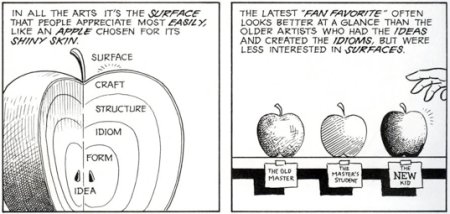
  • All artwork follows six steps (p. 170-1):
Image from: gangles.ca, p. 170 of Understanding Comics
    1. Idea/purpose: "the impulses, the ideas, the emotions, the philosophies, the purposes of the work...the work's content."
    2. Form: book, furniture, music, etc.
    3. Idiom: "the 'school' of art, the vocabular of styles or gestures or subject matter, the genre that the work belongs to...maybe a genre of its own."
    4. Structure: "putting it all together, what to include, what to leave out... how to arrange, how to compose the work."
    5. Craft: "constructing the work, applying skills, practical knowledge, invention, problem-solving, getting the job done."
    6. Surface: "production values, finishing... the aspects most apparent on the first superficial exposure to the work."
Image from: gangles.ca, p. 171 of Understanding Comics
  • After an artist learns to draw, learns how to craft their drawings effectively, learns the proper structure of making an excellent strip (pacing, drama, humor, suspense, etc), and then learns how to instill in the strip their own identity (idiom), it's then that they can decide to become a "explorer" (p. 179) or a "storyteller" (p. 180) - that is to say, either their strip is about art itself, and they experiment with new ways to convey information/stories, or they have a regular/controlled medium and hone their skills at delivering a message as effectively as possible (p. 173 - 180)
  • Color introduction boosted comic sales, but increased cost was also an issue (p. 187)
  • Bright, primary colors were used to counteract the dulling effect of the newsprint, so comics were full of primary colors, without any one dominating the other; this eliminated the emotional impact that could could have had (p. 188)
  • Colors were also consistent with a given character, and thus became a symbol (p. 188)
  • Colors also objectify subjects, bringing attention to the physical form and not just black and white lines (p. 189)
  • When hue and shading starting being introduced in the 1970's, it didn't match the line drawings of the action comics - they fit better with the original 4-color scheme; thus, the surface changed without the core changing (p. 191)
  • While color may bring more reality to a comic strip, that may not be what a reader wants - black and white comic strips will always have a home (p. 192)
  • So, why are comics so important? No human can ever truly know what it's like to be in the mind of another (p. 194), and the only way to at least try is to communicate. There are many ways to communicate, but it's essential that we understand the different forms that can take (p. 198)
  • "Creator and reader are partners in the invisible, creating something out of nothing, time and time again." (p. 205)

Tuesday, August 7, 2012

What's an encyclopedia?

Richard Marshall, at the time of the [1976] publication, was comics editor of Field Newspaper Syndicate, and is recognized as an authority in his field of work.
www.mycomicshop.com

Notes taken from the following text, a compilation of 15 contributors (Richard Marshall authored the selections from which notes have been taken):

Horn, M. (Ed.). (1976). The World Encyclopedia of Comics. New York: Chelsea House Publishers.
  • Dallis background: born in New York City, attended public schools, Washington and Jefferson College (Washington, PA) and Temple School of Medicine (graduated 1938). Residency was at Henry Ford Hospital in Detroit, then private practice in Toledo, OH (p. 193)
  • Dallis drew cartoons for his college newspaper (p. 193)
  • Rex Morgan, MD was an idea created under the support/direction of Allen Saunders - the extent of his assistance is not covered in the text (p. 193)
  • Dallis stopped work as a psychiatrist in 1959 in order to continue writing the strip (p. 193)
  • Marshall gives credit to Dallis, Saunders and Elliot Caplin, accounting for "the major portion of contemporary story strip production"; Dallis converts adventure to domestic/soap-opera (p. 193)
  • "Dallis' characterizations can be interesting (especially in 3-G) but seldom as mature and never as versatile as Elliot Caplin's." (p. 193)
  • While other story strips are dwindling during this time period, Dallis' three strips still run strong (p. 193)
  • Dallis sold the Rex Morgan, MD strip initially to Publishers Syndicate (Chicago), and it launched on May 10, 1948 (p. 580)
  • Creators of Rex Morgan, MD included Dallis, background artist Frank Edington, and other artist Marvin Bradley (p. 580)
  • There are 3 characters who are the core "family" of the strip: Morgan, a 40-something bachelor, his nurse assistance, June Gale, and an elderly friend/heart-patient, Melissa, the matriarch (p. 580)
  • Morgan defines the soap-opera genre, with its "dramatic and tangled plots, and strong characterization" (p. 580)
  • Marshall declares the art work to be "merely competent and never exciting", explaining that they're often entangled in stereotypes (p. 580-1)
    • I assume this to mean that the men are always dashing/handsome, the women young and beautiful, and the villains always have an evil appearance (usually a creepy mustache)

Monday, August 6, 2012

Brian Walker's Take on Dr. Morgan

Brian Walker is the founder and former director of the National Cartoon Museum (previously the Museum of Cartoon Art), and has been part of the creative team producing Beetle Bailey and Hi and Lois. He has taught a course in cartoon history at the School of Visual Arts, and served as curator for over 65 cartoon exhibitions. Source: back book jacket, The Comics: Since 1945.


www.exhibitionsinternational.org

Notes taken from the following text:

Walker, B. (2006). The Comics Since 1945. (N. Columbus & R. Slovak, Eds.) (Paperback.). New York: Abrams.

  • Elements allowing comics to succeed in America include printing/distribution, concentration of populations to urban areas and acceptance of new forms of expression
    • The Yellow Kid is given credit as the first, 1896 (p. 6)
  • First Sunday publication in 1925 was met with resistance by religious groups, claiming that it "is antagonist to the spirit of the Lord's day, and tends to subvert the institution." I guess the comics won that battle (p. 6)
  • William Randolph Hearst and Joseph Pulitzer, owners of the publishing companies battled for employees and readers (p. 7)
  • Richard Outcault, creator of The Yellow Kid and Buster Brown, is credited to the be father of the modern comic strip
    • October 25, 1896, Outcault used speech balloons and sequential paneling, defining the structure of the comic strip for years to come (p. 9)
  • While syndicates allowed artists more freedom and greater visibility, they also had to relinquish their rights to their artistic creations (this is no longer the case) (p. 10)
    • Here's how it works: cartoonist develops idea, submits a sample of strips and Sunday pages to the editors of the syndicates, syndicates provide the content to the newspaper - syndicates split the profit with the cartoonist (p. 11)
  • Newspaper editors often "test drop" a strip to see if there's any backlash (p. 12)
  • "The funnies have endured primarily because comic characters have a universal, timeless appeal. Their daily appearances make them familiar to million. Their triumph make them heroic. Their struggles make them seem human. Cartoonists create friends for their readers. Pogo, Charlie Brown, Calvin and Hobbes, and Dilbert are part of a great cultural legacy that is being further enriched every day. The final panel has yet to be drawn." (p. 15)
  • Boston University readership study (1962) listed Rex Morgan, MD as one of the top 15 features, along with others suggesting that humor versus story was about 50/50 in terms of popularity (p. 74)
  • William Steve, editor of the Houston Chronicle did an official study (1962) declaring Rex Morgan, MD "essential" to any comics page, even though syndicates felt story/continuity strips were fading out of popularity  - this study was admittedly "unscientific and highly opinionated", but it's still a data point (p. 122)
  • The 70's saw the death of many continuity strips, though Rex Morgan, MD continued to thrive (p. 170)
  • In 1980's, the Time-Union (Rochester) canceled Rex Morgan, MD; but only temporarily - the paper received 237 letters demanding its return (p. 226)
    • This also happened for Dallis' other strip, Apartment 3G (p. 226)
  • In 1985: Rex Morgan, MD was in 350 newspapers, Judge Parker in 250, and Apartment 3-G in 200 (these are all Dallis' creations); he believed the success was due to the relevancy of the strips because they "address the problems that are occurring today." Cocaine addiction, FAS and spousal abuse were just some of the topics covered in the 80's (p. 227)

The Soap Opera, Jerry Robinson Style

Jerry Robinson (1/1/1922 - 12/7/2011) was no stranger to comics. He is best known as the artist of the Joker, villain to Batman. He was also inducted to the Comic Book Hall of Fame in 2004 (details found on Wikipedia, to be taken with a grain of salt).
www.darkhorse.com

Notes taken from the following text:

Robinson, Jerry. "The Soap Opera." The Comics: An Illustrated History of Comic Strip Art. New York: G.P. Putnam's Sons, 1974. 174-180.

  • Dealing with real problems both in comic strips and on TV reflected the change in the public's interests (p. 174)
  • Mary Worth, started in 1932, was the first of the soap opera comic strips - though the strip changed hands in 1939 and again in 1942, she continued to address themes such as alcoholism, infidelity and a range of emotional issues women experience (p. 174-175)
  • Allen Saunders took over for the original creator, Martha Orr; he believes the entertainment nature of the strip allows the readers to also learn about themselves (p. 175)
  • Rex Morgan, MD was first published following a national poll by [at the time] Publishers Syndicate, which showed the public wanted "realistic adventure strips about conventional professions." (p. 176)

Tuesday, July 17, 2012

The Anatomy of Comics - Part 2

Notes from: McCloud, Scott. (1993). Understanding Comics: The Invisible Art. New York: HarperCollins Publishers. p. 60-137.

  • Closure - a concept where we perceive a whole/entire experience when we may only actually be observing parts of it (ex. in a vertical stack of books, we assume there are covers and pages between the top and bottom; not because we see them but because we have previously experienced this to be true) (p. 63)
  • The space between panels is called "the gutter", and "plays host to much of the magic and mystery that are the very heart of comics. Here in the limbo of the gutter, human imagination takes two separate images and transforms them into a single idea." (p. 66)
    • It's in the gutter where readers go from reading to participating (p. 69)
McCloud, Scott. (1993). Understanding Comics: The Invisible Art. New York: HarperCollins Publishers. p. 66.
Retrieved from: graphicnovel.zachwhalen.net
  • A few pages are spent on analyzing the different types of transitions between panels
    • Action-to-action predominates in Western culture, illustrating out "getting there" culture (p. 81) as well as perhaps the necessity of accomplishing much in a limited space (p. 80)
    • Action-to-action does predominate in Japanese comics, but to a much lesser degree; subject-to-subject and moment-to-moment panels illustrate a culture that emphasizes "being there" (p. 81) which is permitted in the lengthy anthologies of comics (p. 80)
  • Comics is considered "mono-sensory" - that is, it's entirely visual; however, in the gutters, because no senses are required, all are engaged! (p. 89)
  • The dance between visible and the invisible is a unique property to comics. "No other artform gives so much to its audience while asking so much from them." (p. 92) 
  • Words provide time by representing sound (p. 95)
  • Extending the length of a panel can increase the reader's perception of time, even though the content may be no different than if the panel were narrower (p. 101)
  • Timelessness can be produced when the content leaves no information regarding duration, leaving the reader to ponder the scene even after they've moved on to another panel - this effect is exaggerated when the panel "bleeds" off the edge of a page (p. 102-3)
  • Depicting motion evolved from "wild, messy, almost desperate" lines to lines "so stylized as to almost have a life and physical presence of their own" (p. 111)
  • All lines carry some sort of expression, shape and direction alone influencing the characteristics (p. 125)
  • The use of very basic lines can be used to add emotion or sensual information (smell, sound, etc.) (p. 128)

Rex Morgan, MD and Cocaine

Notes from: Erickson, P. (1987). The Steel Drug: Cocaine in Perspective. (E. M. Adlaf, G. F. Murray, & R. G. Smart, Eds.). Ontario: Lexington Books.

From book jacket: 

Cocaine's popularity among adults as a so-called recreational drug has skyrocketed. Yet, reliable information about the drug and its users remains relatively scarce. This important book fills that gap by providing extensive historical and cultural background on cocaine as well as the results of a remarkably in-depth study of over one hundred adult cocaine users. 


The authors begin by placing the current cocaine crisis in a social and historical context. They discuss the introduction of cocaine into Europe and North America and examine the roots of current legislation aimed at curbing the drug's use. They also highlight the appealing image of cocaine as portrayed in many aspects of popular culture. 


Based on their own study, the authors provide directions for further research and implementation in legal policy, deterrence, education, and public policy. This extensive, thought-provoking work is essential reading for drug treatment professionals as well as all who are interested in the critical problems of cocaine use.


Patricia G. Erickson, Edward M. Adlaf, and Glenn F. Murray are members of the Prevention Studies Department of the Addiction Research Foundation in Toronto, where Reginald G. Smart is the Department Director. The Foundation undertakes research, treatment, and education in the area of alcohol and other substance dependencies.


Notes from Chapter 2 - Cocaine in Popular Culture: Then and Now

  • Popular/mass culture encompasses those "widely accessible forms of transmission of the value, beliefs, and practices of a society." (p. 23)
    • Comic strips definitely fit this definition
  • Unresolved is the issue of whether pop culture follows public opinion or precedes it (or if they influence each other) (p. 23)
  • Cocaine users reported mass media as their source (second to their peers) for expectations of cocaine (p. 23)
  • With the counterculture movement of the 1960's came many songs referring to drugs both directly and indirectly; the consequence was the Federal Communications Commission stepping in (1971) to regulate lyrics, when the US Army expressed concerns (p. 24)
  • Literature: Sherlock Holmes almost required cocaine for mental stimulation - example given is from The Sign of Four published in 1886 (p. 25)
  • Biographies highlighted the use of cocaine among the social elite (due to its high cost) and within the entertainment industry (p. 26-7)
  • One study in 1978 by Gerbner suggested 1/5 action comic characters used drugs to gain their superpower (p. 27)
  • Rex Morgan, MD exemplifies the stigmatization - Claudia Bishop is a social/recreational user but is seeing Dr. Morgan because she can not control her habit, 1985 strip (p. 27-8)
  • Cocaine is sensationalized in newspapers, infiltrating previously unrelated activities/interests such as Sports Illustrated magazine (p. 28)
  • Hill (1985) found a weak relationship between public concerns and the political/social content of national news programs, which is contrary to a study by Duster (1970) suggesting that television news influences public opinion, not the other way around (p. 29)
  • A sharp increase in articles published from 1981 - 1984 depicting cocaine in a negative light could have served to legitimize the "sick role" of cocaine addicts; The National Institute on Drug Abuse reported an increase in those seeking treatment during this time period (p. 30)
  • Movies and television also portray cocaine negatively (p. 31)
  • Image of cocaine users is a paradox - they are often people of high social status, yet the consequences of addiction are detrimental (p. 32)

Monday, July 16, 2012

A Word from George Basalla

Notes from:  Basalla, G. (1976). Pop Science: The Depiction of Science in Popular Culture. Boston Studies in the Philosophy and History of Science. Reidel Publishing Company. doi:978-90-277-0657-7

  • "Popular science" is science that is restricted to a highly-educated group, mostly the scientific community; this is not where comics fit in
  • "There exists a feedback loop between widely-held American ideas of science and their popular artistic representation in comic strips, television shows, and feature films." (p. 261)
  • Like many other authors, Basalla agrees "pop science" - an aspect of the popularization of science - is understudied and under-appreciated (p. 261)
  • During the golden age of comic books (1938-1954), doctors/scientists were depicted as ruthless, heartless, and willing to sacrifice any and all for the secret formula (p. 262)
  • With the 1960's came Stan Lee's Marvel Comics, introducing a new "social conscience" in plots and expanding the audience from young boys to college students (p. 262)
  • Most scientists depicted were those who transformed into monster-like creatures: Dr. Bruce Banner & The Hulk, Dr. Jekyll & Mr. Hyde, Chemist Ted Sallis & Man-Thing, Dr. Curtis Connors & The Lizard (p. 262-3)
Caught in the blast of gamma radiation, brilliant scientist Bruce Banner is cursed to transform in times of stress into the living engine of destruction known as THE INCREDIBLE HULK.

More on Marvel.com: http://marvel.com/universe/Hulk_(Bruce_Banner)#ixzz20oinDsyn
  • Stan Lee continued the portrayal of scientists as tending towards "mental instability and social irresponsibility" (p. 263)
  • Reference: 134 million copies of Marvel Comics distributed v. 6.85 million Scientific American (no date given on the reference) (p. 263)
  • Those not portrayed as evil are flawed; he is either naive or overly obsessed and cannot see the resulting consequence of his research - in the end, his work results in the same consequences as the mad scientist
  • The "good" scientists that we see are usually assistants or lab technicians that do all of the work but receive no recognition or glory
    • Good example, the techs that work in the lab assisting Dick Tracy's detective work (p. 265)
  • A quick comment is made about how medical doctors may be excused from this depiction because of their necessity of interacting with the public in both social and political systems
    • "Rex Morgan, MD can truthfully be shown in a comic strip as a faithful servant of society." (p. 271)
  • Scientists often referred to as "they", as if they're hidden away from society (p. 272)
  • An estimated 100 million Americans read at least one comic strip in the Sunday papers, and at least 90 million follow a favorite character in daily episodes - this at a time when the population was 211 million (p. 276)
  • "...the individuals whoa are in a position to reach substantial numbers of Americans with their conception of science are therefore not science writers and journalists...it is rather the persons who produce popular television shows and feature films, along with the cartoonists of the favorite comic strips - in short the creators of popular culture - for whom the wide American public receives its portrayals of science and scientists." (p. 276)
George Basalla's take on the scientist being portrayed negatively doesn't appear to affect the medical doctors, however, I think it's interesting to include this angle when considering the audiences reading The Hulk and Dick Tracy may be similar to those that may be reading Rex Morgan, MD. The critical argument that he makes is in the power of "pop science" to influence the public.

Friday, July 13, 2012

1977 Comic Strips: A Summary

Source*: Curtis, Dal. Rex Morgan, MD. 1 Jan - 31 Dec 1977, Field Newspaper Syndicate (Chicago, IL). 
*p. 626-678 on disk from King Features Syndicate.


All comic strips are posted online by special permission of King Features Syndicate, Inc.
  • January 1 - February 2: Mary Gordon, oppressed wife of a surgeon (see 1976)
  • February 2 - June 13: Paul Belmont, mob boss 
    • Danny Belmont, a 6-year-old boy comes into Dr. Morgan's office due to car accident that June witnesses. It's critical at first (an artery is severed) but is quickly mediated. We learn quickly that he has a dedicated father, and has not spoken a word since his mother died one year ago (he witnessed "his mother blown apart before his eyes")
    • This story is briefly interrupted by a homicide (3/2/77); Dr. Morgan receives a gunshot victim, but is dead on arrival - the police suspect it was a professional job; fingerprints point to a mob killing
Rex Morgan, MD - March 3, 1977    © King Features Syndicate
    • Danny instantly gets attached to June, who visits for dinner - we get snippets of Paul Belmont's professional life - a man named "Garrity" has been murdered and an emergency board meeting is being called
      • Victor Lambros cannot be reached - unacceptable!
      • June also suggests Danny sees a psychiatrist for his separation issues
    • Paul believes his wife was murdered and has been trying to track down the murderer every since - Garrity was supposedly to provide information
    • While Melissa shares Paul's life story with June, Danny runs away and is found in the bushes by the police
    • Paul turns to the DA when learning his wife and friend (Garrity) were killed by one of his own men
    • The stories are ending more abruptly - the conclusions seems to have less grandeur to them...
  • June 13 - January 27, 1978: Dr. Jim, "cancer specialist"
    • When Dr. Adam doesn't show up for work, an anonymous phone call says that he would be in touch in the morning
    • He's been taken hostage by some criminals (wanted for armed robbery) trying to nurse a young woman, Jeannie, back to health without involving authorities
    • Brice writes a false prescription to quietly alert authorities; meanwhile, Jeannie falls into a coma
    • Jeannie has bacterial meningitis, but survives once put on IV antibiotics
    • Jase, the leader of the pack, comes down the with same and dies on the way to the hospital
    • Billy, the youngest of the three, is hospitalized for observation, but attempts escape
    • Brice appears to be taking a personal interest in Billy
Rex Morgan, MD - August 13, 1977    © King Features Syndicate
    • Brice takes Billy shopping, gives him car and apartment keys so he can turn his life around
    • Dr. Morgan tries to connect Billy with Ellen Glenn, personnel manager of the local auto parts shop; she's due for a physical, and plans to hide her cancer treatments from him (per her 'oncologist's' wishes) Dr. Jim seems a bit dodgy - I think the artist wants us to know this by giving him a mustache more similar to previous criminals than the clean-cut physicians  
Rex Morgan, MD - October 5, 1977    © King Features Syndicate
    • It's evident that Dr. Jim is a nasty fraud, while his assistant, Charlotte, appears to have a smidge of a conscience
    • In an ironic turn of events, Billy picks up work both at Ellen's auto shop, and then cleaning at Dr. Jim's "Health Clinic" in the evenings
    • We get a good strip on cancer education (it's been a while since we've seen one of these):
Rex Morgan, MD - November 10, 1977    © King Features Syndicate
    • Ellen almost dies after a cancer "shot", but Billy saves her by phoning Dr. Adam in time
    • Brice confronts Dr. Jim - Go, Brice, go!
Rex Morgan, MD - December 20, 1977    © King Features Syndicate
    • The plot becomes more intense when Charlotte backs out of the operation and is caught trying to take money from their safe
Rex Morgan, MD - January 7, 1977    © King Features Syndicate
    • Dr. Jim is arrested, and Charlotte recovers well at the hospital
    • The story shifts slightly to focus again on Billy, and his new friends at work, who appear to be plotting something evil and including Billy in their plans - the poor kid can't catch a break! 
    • See details in 1978!

1976 Comic Strips: A Summary

Source*: Curtis, Dal. Rex Morgan, MD. 1 Jan - 31 Dec 1976, Field Newspaper Syndicate (Chicago, IL). 
*p. 574-626 on disk from King Features Syndicate.


All comic strips are posted online by special permission of King Features Syndicate, Inc.
  • December 29, 1975 - April 9, 1976: Norm & Elizabeth Prescott
    • We start in the middle of a story, with Rex's new patient, Mr. Norm Prescott - who has already given June a vase of roses (shocker!)
    • Norm needs a complete physical to take out a $2M insurance policy
      • Preliminary blood tests are suspicious and need to be repeated: elevated WBC count and abnormal cells
    • Rex watches (looking concerned only when by himself) as June is wooed by yet another dashing, exciting young man
    • June is whisked away to Philadelphia with Norm for the night, and answers an agitated phone call from Mrs. Elizabeth Prescott about their son (yikes!) - we learn a few days later that they're divorced, and that there's an argument over money and their son - Norm makes it clear he's only concerned about his son, not the money
    • Norm's charm wears off as all of his dates with June are constantly interrupted by work phone calls
    • Norm drinks alcohol and takes sleeping pills - not an intentional suicide attempt - after realizing that they want to admit him to the hospital for further testing
    • We learn that he's previously had tests, and been told he has leukemia
Rex Morgan, MD - March 19, 1976    © King Features Syndicate
    • Unknown to Norm, his little boy and wife have arrived at the airport
    • Norm is surprised to see Elizabeth, but makes an effort to concentrate on her - he asks them to move back to the house
    • We also learn Norm does not have leukemia, and was just fighting off mono
    • This story is interrupted by an emergency phone call for Rex...
  • April 9 - September 7: Becky Barrett, Barbara & Brick
    • Becky initially refuses treatment - she's quite a rebel - but eventually allows Rex to examine her
    • Her father is concerned that they no longer communicate well
    • Becky is released, and a man name Brick Cutler picks her up
    • Becky runs into Rex and June on a date; on their way out they see Brick hitting Becky (out of jealousy):
Rex Morgan, MD - May 15, 1976    © King Features Syndicate
    • As Rex and June drop Becky off at home, she finds her father unconscious on the floor - Rex is able to get him stabilized in the ER
    • Becky thinks her father divorced her mother because of his secretary, 15 years ago
    • We learn that Brick has been shot and killed
    • Barbara Sears, Mark's secretary, agrees to stay with Becky while her dad is in the hospital
    • Becky does not give an accurate story to the police about her last interaction with Brick when questioned about his death
    • The police make a comment about "this day and age", and that Brick may have been murdered for drugs:
Rex Morgan, MD - June 23, 1976    © King Features Syndicate
    • Becky has had an apparent change of heart and is showering Barbara with compliments when they visit Mark at the hospital - it's kind of suspicious...
    • Rex brings up open heart surgery to Mark, suggesting the only alternative is to live with bouts of chest pain
    • Barbara admits to Rex that she shot Brick - unintentionally (we believe her) - when it started to appear Becky was to be accused of murder
    • The story seems to end abruptly, with Barbara's confession and Mark's open heart surgery; it picks up again on 9/17
  • September 8 - February 2, 1977: Mary Gordon, oppressed wife of a surgeon
    • Dr. Wes Gordon's wife, Mary, phones Brice in a drug/alcohol-induced stupor
    • She leaves the hospital against orders for fear of embarrassing her surgeon husband
    • She makes several comments where she feels trapped by the stereotype of a surgeon's wife, unable to work as a waitress or go back to school:
Rex Morgan, MD - September 28, 1976    © King Features Syndicate
    • Apparently Dr. Gordon's study is "off limits" to his wife when he's reading!
    • When he gets home from his fishing trip he's upset to find Mary has gone back to school. The nerve! He becomes angrier when she's not home for lunch - she must be out of her mind!
    • Dr. Gordon bumps into a couple of women at a bar, and ends up flirting and going out with Sherri Wade, an artist
    • Wes then lies to Mary about his plans - he's going to "watch Sherri paint" in the afternoon but tells her he has committee meetings. I'm not impressed.
    • Rex is quite bold and confronts Wes directly about his marriage and Mary:
Rex Morgan, MD - December 4, 1976    © King Features Syndicate

    • While Wesley is out on a date with Sherri, his patient receives emergency surgery for a bowel obstruction
    • We break again for an off-topic, yet lovely, Christmas panel (in reading Scott McCloud's book, Understanding Comics, the use of a single, full panel helps to exaggerate expansive time/meaning - how perfect for Christmas cheer!)
Rex Morgan, MD - December 25, 1976    © King Features Syndicate
    • Wesley calls Sherri at 3am to tell her they can't see each other anymore, but they're struck by a drunk driver on their way home
    • The story ends quite abruptly - there's initial concern Wes will lose his arm (or its function), but is quickly given a good prognosis; Sherri is discovered to be shallow and Wes makes up with Mary

Thursday, July 12, 2012

The Anatomy of Comics - Part 1

A few quick comments about the author of the book I'll be taking notes on, Scott McCloud:

From Wikipedia: Scott McCloud (born Scott McLeod on June 10, 1960) is an American cartoonist and theorist on comics as a distinct literary and artistic medium. He is most notable for his non-fiction books about comics, Understanding Comics, Reinventing Comics and Making Comics, for which he has been called the "Marshall McLuhan of comics." ...He is best known as a comics theorist or as some say, the "Aristotle of comics",[6] following the publication in 1993 of Understanding Comics, a wide-ranging exploration of the definition, history, vocabulary, and methods of the medium of comics, itself in comics form.

And a few separate comments on the book, Understanding Comics:

From Wikipedia: "Understanding Comics: The Invisible Art is a 215-page non-fiction comic book, written and drawn by Scott McCloud and originally published in 1993. It explores the definition of comics, the historical development of the medium, its fundamental vocabulary, and various ways in which these elements have been used. It discusses theoretical work on comics (or sequential art) as an artform and a communications medium. It also uses the comic medium for non-storytelling purposes."

Notes from: McCloud, Scott. (1993). Understanding Comics: The Invisible Art. New York: HarperCollins Publishers. p. 2-59.
McCloud, Scott. (1993). Understanding Comics: The
Invisible Art.
 New York: HarperCollins Publishers. p. 9.
Retrieved from: motleyvision.org

  • While stories told in picture form have been around for thousands of years, it wasn't until printing was established that the medium could be enjoyed by everyone and not just the wealthy (p. 16)
  • McCloud gives credit to Rodolphe Topffer as the father of modern comics, defining them as using panel borders, cartooning, and interdependent combinations of words and pictures
  • Goethe criticized Topffer for choosing a "frivolous subject" and ignored is works as anything worth potential (p. 17)
  • A useful definition of comics: "Juxtaposed pictorial and other images in deliberate sequence, intended to convey information and/or to produce an aesthetic response in a viewer." This means that single panels are CARTOONS, and not COMICS. (p. 20)
  • Cartoons = "an approach to picture-making... a style"; Comics = "a medium which often employs that approach" (p. 21)
  • An icon is "any image that used to represent a person, place, thing or idea." (p. 27)
  • Pictorial icons are variable in the sense that they differ from the real life appearnce in varying degrees (p. 28)
  • McCloud asks the question, why do we respond to abstract/simplified icons as much - or more so - than the drawings which are more realistic? He suggests that with simplification the artist is able to amplify characteristics that might otherwise be lost in a more complicated, life-like image (p. 29-30). Cool, right?!
McCloud, Scott. (1993). Understanding Comics: The Invisible Art. New York: HarperCollins Publishers. p. 30. Retrieved from: idrawdigital.com
  • Cartoons allow us to focus our attention on a idea, and have a universal characteristic (the more cartoony a face, the more it could look like a greater number of people) (p. 31)
  • Also incredible is our ability to see faces in the most non-human structures (picture an outlet!) - what's better is that it's almost impossible NOT to see faces in inanimate objects (p. 32)
  • When we converse, we have an awareness of our own face even when looking at our speaking partner - however, it's a much less detailed image - more of a "sketchy arrangement... a cartoon"!! So when we enter the world of cartoons and comics, we see ourselves. (p. 36) Is your mind blown? Mine is.
  • When less realism is in the drawing, then the message becomes more important than who/what it's coming from (p. 37)
  • Cartoons hold an advantage of breaking into pop culture due to the degree of audience identification, an indicator of audience involvement (p. 42); furthermore, the background has more latitude in how real it appears because we do not identify with brick walls or landscapes. "This combination allows readers to mask themselves in a character and safely enter a sensually stimulating world. One set of lines to see. Another set of lines to be." (p. 43)
  • The total "pictorial vocabulary" can be defined within a triangle, the vertices being reality, language and object/picture (p. 51)
  • McCloud, Scott. (1993). Understanding Comics: The Invisible Art. New York: HarperCollins Publishers. p. 51.
    Retrieved from: xradiograph.com
    • An artists values can be extrapolated from where in the triangle their art lies: nature = lower left (reality), art = top (object/picture), ideas = lower right (language) (p. 57)
    • Mention of Marshall McLuhan - to be researched! Quick peak on Wiki describes him critical in the study of media theory (p. 59)
I haven't yet figured out how to add pictures to the blog using my mobile app yet (yay, iPad) - but as soon as I do I'll come back and make this a little more fun, especially since this is such a visually-oriented discussion on comics.

Wednesday, July 11, 2012

1975 Comic Strips: A Summary

Source*: Curtis, Dal. Rex Morgan, MD. 13 Jan - 31 Dec 1975, Publishers-Hall Syndicate (Chicago, IL). 
*p. 517-574 on disk from King Features Syndicate.


All comic strips are posted online by special permission of King Features Syndicate, Inc.
  • January 1 - 13: MISSING
  • January 13 - 15: Ben Salvo
    • It appears the Salvo story still continues - Rex is talking to a young lady named Jenny, who's in a hospital bed. Ben has left her a small trust, even when he knew she was with a man named Al Davison (Ben must have been in love with Jenny?)
    • It's hard to say what happened in this story
  • January 16 - May 29: Carl Holden, mental illness
    • Brice Adams is called by a mysterious woman, and he leaves immediately - he meets with a young woman named Christine "Chris" Holden (who we learn is his girlfriend), who is upset that her ex-husband, Carl, has been paroled and wants to see her
      • Carl nearly killed a man "and practically made a vegetable out of another"
    • Carl takes the day off with Chris, but Carl follows them
    • February 2 - 9: MISSING
    • It appears Carl is being respectful about his apologies to Chris and her interest in Brice
    • Carl calls Rex out to his farmhouse when his worker, Eddie, has a coronary - Chris is worried that he's falling back into his old ways
Rex Morgan, MD - March 19, 1975    © King Features Syndicate
    • Carl has a breakdown and threatens Rex that Brice needs to stay away from his "wife"
Rex Morgan, MD - April 25, 1975    © King Features Syndicate
    • Carl gets in a fight with both Brice and the cops, who are now chasing him after he sped off when he could not produce a license when pulled over for speeding
    • We miss a critical week in the suspense of what will happen to Carl - Chris is on her way to the farmhouse against advice, and Carl is waiting with a shotgun
    • May 17 - May 25: MISSING
    • The situation seems to have been resolved, with Carl being hospitalized - given a good prognosis being put on lithium
Rex Morgan, MD - May 27, 1975    © King Features Syndicate
  • May 29 - xxx: Keith Cavell, back in town, and introducing Valerie Layne
    • As Keith leaves his hotel room, he overhears the owner being held up at gunpoint
    • "As Dr. Keith Cavell thwarts an early morning motel holdup, he is shot by one gunman!"
    • Keith was passing through town on his way to see a woman, Valerie Layne, whom he'd met in Africa with her husband
      • Mr. Layne died in a plane crash 10 days prior, and Keith was visiting her to make sure she was okay; Valerie comes to him since he's hospitalized
    • When suggesting Keith join Rex's practice he mentions that he may not like it because "medicine has changed in the last few years" - he goes on to mention malpractice
Rex Morgan, MD - July 7, 1975    © King Features Syndicate
    • While Keith is preparing to propose, Valerie learns her husband's plane crash was due to sabotage, and that she's falling in love with Rex - what a day!
    • Melissa has another "heart flutter"
    • Keith is upset with Rex, thinking that he's moving in on Valerie
    • Rex goes with Valerie to meet the investigator on Bill's death in the plane crash
      • I find myself feeling very protective over Rex - I get angry when he flirts with anyone but June!
    • For the first time, we learn that Rex Morgan is bad at something - mechanics! I guess he is human, after all.
Rex Morgan, MD - October 8, 1975    © King Features Syndicate
    • Luckily, Valerie seems to be quite the mechanic - for claiming she knows nothing about planes, I'd say she's incriminating herself in her husband's death
    • The story is cut short, but here's the last strip we have in the story:
Rex Morgan, MD - October 25, 1975    © King Features Syndicate
    • If I had to guess, they probably nail Valerie for sabotaging her husband's plane - I hope that Rex and Keith made up, and that stories were set straight (Rex was not trying to hit on Valerie, as Keith suspected...)
  • October 26 - December 28: MISSING
  • December 29 - 31: (see 1976)

1974 Comic Strips: A Summary


Source*: Curtis, Dal. Rex Morgan, MD. 12 - 24 Aug 1974, Publishers-Hall Syndicate (Chicago, IL). 
*p. 515-516 on disk from King Features Syndicate.


All comic strips are posted online by special permission of King Features Syndicate, Inc.

  • January 1 - August 11: MISSING
  • August 12 - 19: Wade Norton & his daughter, Janie... and a proposal
    • We start in the middle of a story with: "Having told June that he knows about Janie's phone call to her, Wade Norton than asks a question."
    • Oddly enough, we start this story with another proposal for June! Guess Kenny Baron didn't make the cuts!
  • August 17 - 24: Ben Salvo & his young wife
    • Ben Salvo, 28 years older than his wife, passes away, leaving a mysterious letter to Rex
      • Seems like his wife is messing around with another man... tsk tsk
    • The story is cut short due to missing strips
  • August 25 - December 31: MISSING